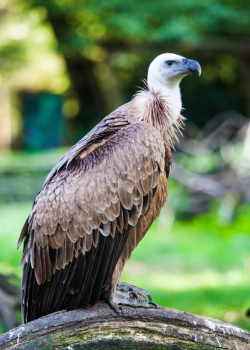
Being endangered, The Centre does a lot of work with different species of Vultures. The numbers of Cape Vultures are declining daily due to injuries and poison.
Cape Vultures are beautiful birds and can reach the age of 40 – 60 years in captivity. They pair up for life and are also very difficult to breed with.
COMMON NAME: Cape Griffon Vulture
SCIENTIFIC NAME: Gyps bengalensis
TYPE: Bird
DIET: Carnivore
GROUP NAME: Committee
AVERAGE LIFE SPAN IN THE WILD: Up to 10 years
SIZE: 75-85 cm (30-34 in) high at shoulder
WEIGHT: 1.5-11 kg (3-24 lbs)
Videos
Interesting Facts
Across Africa, vultures are electrocuted by power lines or crushed by wind turbines. Their brains are ground to snuff by witch doctors who believe the substance has magical powers. They die after eating pesticide-laced carcasses intended for lions and other predators.
As a result, vulture populations are plummeting.
Africa’s eight vulture species have declined in number by an average of 62 percent during the last 30 years, according to the first estimates of a continent-wide decline in the large birds. Six of those species would likely be considered critically endangered by the International Union for Conservation of Nature.
While vultures are not cute and cuddly, they are one of nature’s most important scavengers—a flock can strip a carcass in a matter of minutes, said study leader Darcy Ogada, assistant director of Africa Programs for the Peregrine Fund, an Idaho-based nonprofit dedicated to saving birds of prey. (Read more about Ogada’s work in her own words.)
But Ogada predicts these natural recyclers, which breed slowly and need years to mature, could be extinct in Africa in the next 50 to 100 years.
“The impact of their declines are huge,” Ogada says, whose research is funded by National Geographic. “They’re providing such a huge service to such a huge population.”
Tracking the Birds
In 2012, Ogada and colleagues extensively reviewed scientific literature on Africa’s vulture populations, as well as unpublished data from road surveys and counts of dead vultures.
The team analyzed the data by assigning a vulture species in each country to one of four categories: extinct or in severe decline, strong decline, moderate decline, or no decline.
Of the 95 vulture populations they examined, 85 (or 89 percent) were either nationally extinct or had experienced severe declines, according to the study, published recently in the journal Conservation Letters.
The scientists also studied the major threats to African vultures based on data from published and unpublished articles, as well as media reports, drawn from 1961 to 2014.
That work revealed that poisoning from eating pesticide-laced carcasses caused as many as 60 percent of the vulture deaths recorded since the 1970s.
When a large predator such as a lion kills livestock, a farmer will sometimes sprinkle poison on the carcass to kill the predator in retaliation, a practice that’s illegal but rarely prosecuted. Vultures usually get to the corpse—and the poison—first. (Related: “Lions, Hyena Killed With Poisoned Meat.”)
Pesticides are poorly regulated and abused in Africa, adds Ogada. Usually sold as “lion killer” in several African countries, many farmers don’t know what the chemicals are really used for.
Vulture Threats
David Allan, curator of birds at the Durban Natural Science Museum in South Africa, studies Cape vultures in South Africa. He says these vultures have largely disappeared from commercial farming areas in the country where pesticide use is routine.
But there are various threats beyond pesticides, he notes.
Thank you to “National Geographic” for the amazing informative content.
Would you like to adopt a wild child?
Click on one of the species below to see who’s available!
make your reservation here