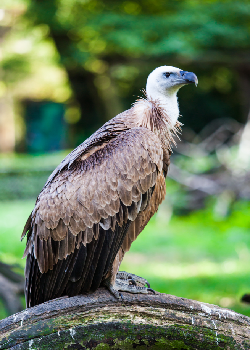
The lappet-faced vulture is a large bird with a heavy head and massive bill. It has mainly dark feathers and is easily identified by its bare pink head and large, fleshy folds of skin on the sides of its neck.
The bird is mainly a scavenger, feeding predominantly on any large carcasses or their remains. It is also known to hunt, probably taking a variety of small reptiles, fish, birds, and mammals, and has been observed apparently group-hunting flamingo chicks.
COMMON NAME: Lappet-faced vulture
SCIENTIFIC NAME: Torgos tracheliotos
TYPE: Carnivorous
GROUP NAME: Wake
AVERAGE LIFE SPAN IN THE WILD: 20 to 50 years
SIZE: Approximately 100 to 105 cm (39.5 to 41.5 in.); wingspan 2.6 m (8.5 ft)
WEIGHT: Up to 13.6 kg (30 lbs.)
Videos
Interesting Facts
Fun Facts
Ecology and Conservation
The scavenging behavior of the Lappet-Faced Vultures helps break down and recycle animal matter. They aid in the removal of carcasses and help to prevent the spread of disease.
Vulture eggs and young are prey for other predators such as crows.
Widespread accidental poisoning, largely due to strychnine, used by many farmers for predator control, and more recently carbofuran, has contributed significantly to declines.
The upper beaks of these birds may be traded for traditional medicine and they are also often mistakenly persecuted as a livestock predator.
The total population is estimated to be declining at a very rapid rate. Ogada et al. (2016) estimated the population in Africa could decline by 80% in just over three generations.
make your reservation here